Reproducible western blot for quantitative research

Stop fighting cross-gel variability
No cross-gel variability.

Run a full dose-response or time course on a single gel, with every replicate and control under identical conditions. Reproducibility built into the format, not fought for after the fact.

No new instrument

A tank, not a new platform to defend.

96 conditions per gel

Doses, timepoints, and replicates together.

Peer-reviewed, NIH-funded

Ready to cite in a methods section.

One normalization

Across the whole experiment.

Splitting an experiment across gels adds noise to the result you're trying to model

A dose-response matrix or a time course needs more conditions than a standard gel can hold. Splitting it across five to seven gels means normalizing across all of them, and every one of those normalizations adds noise.

Reviewers and funders have gotten stricter about replication and normalization, and cross-gel variability is one of the first things flagged. The usual responses are to run more replicates, which multiplies the gels, or to defend the normalization approach in the methods section.

G96 holds up to 96 samples, so the entire condition set runs on one gel with one normalization. The variable is removed instead of corrected for.

A 72 to 96 condition experiment

1 gelVersus five to seven standard gels
1Normalization for the entire experiment
SameAntibody sensitivity and detection chemistry
30 µLPer well, for low-abundance targets in dilute lysate
How a quantitative western blot runs on one gel

A standard western blot from start to finish. The gel holds more conditions; nothing else about the process changes.

Step 1: Load

Dose-response and time course on one gel

Load up to 96 conditions, replicates, and controls at up to 30 microliters per well, using existing sample prep and Laemmli buffer.

Step 2: Run and transfer

One run, one transfer

Run in the HT-1 horizontal tank on a standard power supply, then wet transfer to nitrocellulose or PVDF. Every condition sees the same run and transfer.

Step 3: Detect

Validated antibodies, one normalization

Probe with the antibodies already validated in your lab, image on your existing system, and normalize once across the full experiment.

Reduce gel-to-gel variability in western blot experiments

  • A 72 to 96 condition dose-response or replicate set runs on one gel instead of five to seven.
  • One normalization for the entire experiment instead of five to seven separate normalizations.
  • Cross-gel variability removed at the source rather than corrected statistically.
  • Same antibodies and protocols already validated in the lab, so there is no new method to defend.
  • Up to 30 microliters per well, which matters for low-abundance targets in dilute lysate.
  • No new instrument beyond the HT-1 tank, and no proprietary reagents.
Dose Response

One-gel western blot vs. a multi-gel workflow

G96Standard 15-well gel workflow96-well precast alternative
Gels for a 72 to 96 condition set15 to 71
Normalization rounds1, all conditions on one gel5 to 7 separate normalizations1, but fixed gel percentage limits separation
Cross-gel variabilityRemoved at the sourceA known rigor concernRemoved at the gel level
BuffersLab's existingLab's existingProprietary loading buffer plus a priming step
AntibodiesAlready validated in the labAlready validated in the labAlready validated in the lab

Peer-reviewed evidence you can cite in a methods section

The format is backed by NIH-funded, peer-reviewed work. If a reviewer questions the method, that citation is the answer, and it belongs in the methods section alongside the antibodies.

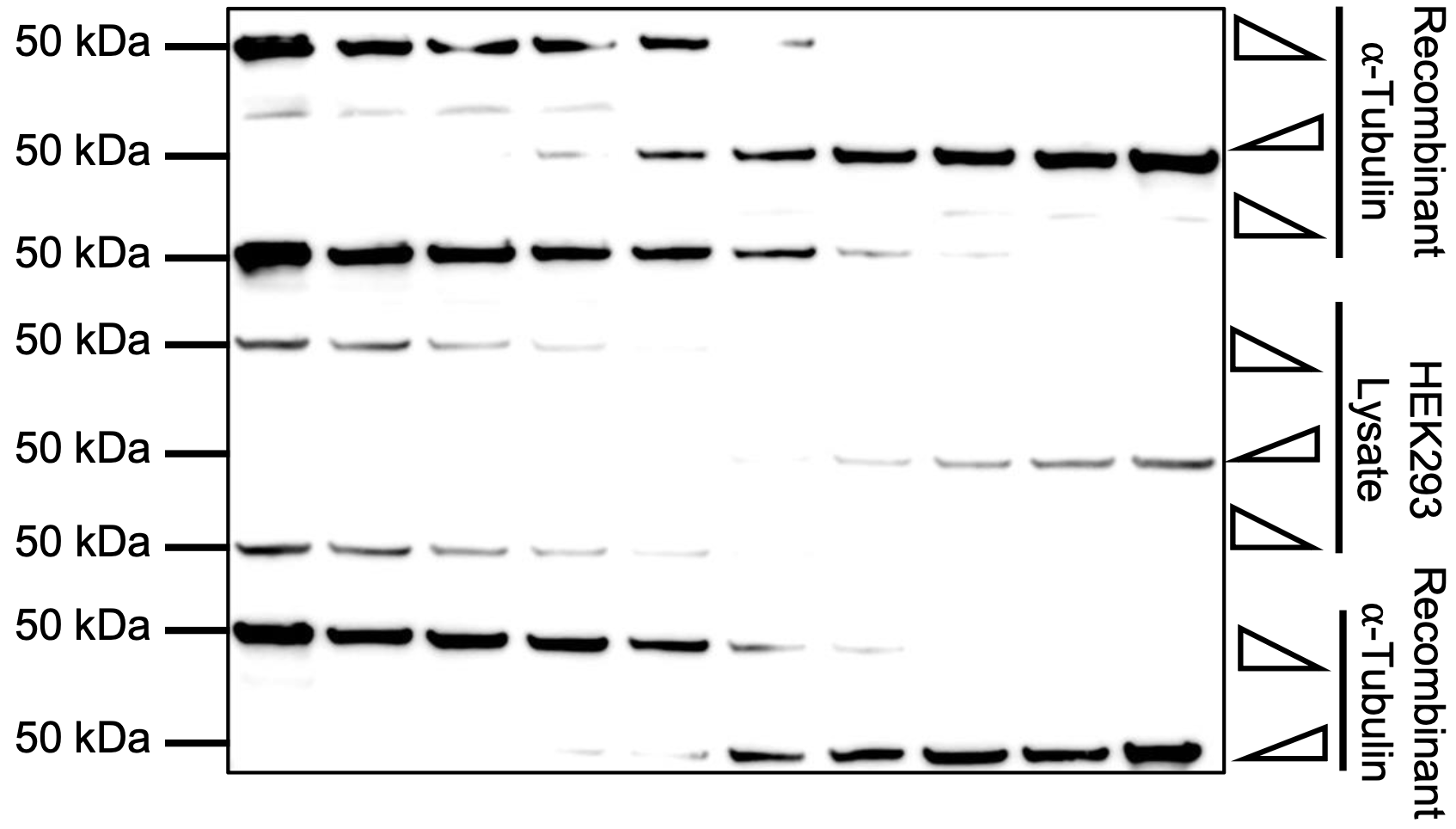
Serial dilutions of recombinant alpha tubulin were run on a traditional western blot gel and a G96 gel, transferred to the same membrane type, incubated with the same antibodies, and detected with the same chemiluminescent substrate, showing equivalent sensitivity.

Built in an academic lab

The founders hit the same throughput and normalization wall in their own NIH-funded research and engineered the fix.

Generate your own pilot data

A loaner evaluation lets you run one experiment on your own samples before you commit further.

G48 and G96 precast polyacrylamide gel specifications

  • G48: 48-well precast gel, single or multi-channel loadable.
  • G96: 96-well precast gel, runs up to 96 samples in about one hour.
  • Tris-HCl chemistry, compatible with standard buffers.
  • Up to 30 microliters loading volume per well.
  • Compatible with standard power supplies, sample types, and wet transfer systems.
  • Nitrocellulose and PVDF membranes both supported.
  • Works with standard blocking and washing buffers, antibodies, and detection chemistries.

Quantitative western blot questions

Is the data quantitatively as reliable as a standard blot?

The antibody sensitivity and detection chemistry are the same as a standard western blot. What changes is the number of gels and the number of normalizations, not the underlying biology or the detection method.

Can I use my existing antibody?

Yes. Standard antibodies and protocols, with no proprietary reagents required.

Will a reviewer flag this as a novel or unvalidated method?

The format is supported by a peer-reviewed publication and NIH funding, which is the citation to give if a reviewer asks.

There are no published studies from labs like mine yet. How do I know it holds up?

The format itself is backed by peer-reviewed, NIH-funded work, and that is the citable evidence today. A loaner evaluation lets you generate a pilot dataset on your own samples before you commit further.

What do I need to get started?

The HT-1 tank and the gels. Your antibodies, buffers, transfer setup, and imaging system stay the same.

Generate your own pilot data first

Run one experiment you would otherwise split across six gels and compare the normalization for yourself.