High throughput western blot for core facilities
Up to 96 samples on one gel, at the antibody sensitivity your users already trust. Same antibodies, buffers, and protocols, with no new validation cycle for the facility to absorb.
One gel and one transfer round, not seven.
Clear more of the queue in a single run.
An answer ready when a PI asks.
Same antibodies and protocols as today.
Core facilities are measured on turnaround and on cost recovery. Both come down to how many samples you can process per instrument-hour and what each data point costs to produce.
Traditional 15-well gels put a hard ceiling on both. Running 96 samples means roughly seven gels, seven runs, and six to seven separate transfer and antibody incubation rounds, each one consuming reagents and staff time.
G48 and G96 change the gel format, not the workflow. The bottleneck moves without the facility taking on a new platform, a new reagent line, or a new method to validate.
A standard western blot from start to finish. The gel holds more samples; nothing else about the process changes.
Load up to 96 samples, replicates, and controls at up to 30 microliters per well, using the buffers and sample prep already in use.
Run in the HT-1 horizontal tank on a standard power supply, then wet transfer to nitrocellulose or PVDF.
Probe with the antibodies your users already rely on and image on the facility's current system. One incubation covers all 96 samples.
| G96 | Standard 15-well precast gel | 96-well alternative format | |
|---|---|---|---|
| Samples per gel | Up to 96 | 15 | 96 |
| Gels needed for 96 samples | 1 | About 7 | 1 |
| Transfer and antibody rounds | 1 | 6 to 7 | 1 |
| Dedicated instrument | No, HT-1 tank only | No | Yes |
| Sample volume per well | Up to 30 µL | Standard | 10 to 15 µL |
| Antibodies and buffers | Lab's existing | Lab's existing | Proprietary loading buffer |
The sensitivity and throughput data behind G48 and G96 come from NIH-funded, peer-reviewed research, not internal testing alone. When a PI asks whether the format has been validated, the answer is a publication you can hand them.
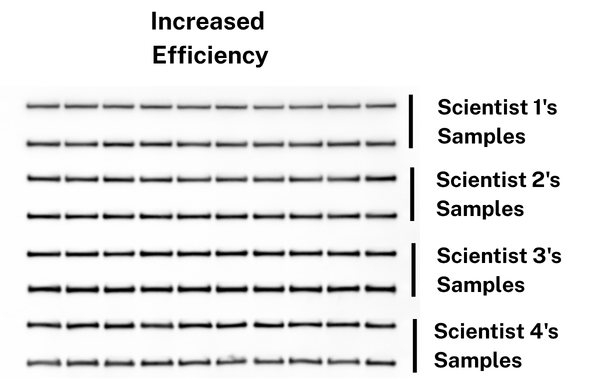
Serial dilutions of recombinant alpha tubulin were run on a traditional western blot gel and a G96 gel, transferred to the same membrane type, incubated with the same antibodies, and detected with the same chemiluminescent substrate, showing equivalent sensitivity.
Founded by an NIH-funded lab that ran into the throughput limit in its own research and engineered the fix.
A loaner evaluation lets the facility run its own samples and antibodies before committing budget.
Yes. G48 and G96 run on the same antibodies, protocols, and standard buffers already in use. There are no proprietary reagents and no new validation cycle for the facility to absorb.
Yes. The sensitivity and throughput data are peer-reviewed and NIH-funded, not a vendor benchmark.
This is not a vendor switch. G48 and G96 run on the antibodies, protocols, and imaging system the facility already uses. It is a change to the gel step only, and it leaves existing reagent and imaging relationships in place.
That is what the loaner evaluation is for. Run the facility's own samples and antibodies on a loaner HT-1 tank before committing budget, and generate the proof in house rather than relying on someone else's case study.
The HT-1 tank and the gels. Everything else, including antibodies, buffers, transfer equipment, and imaging, stays as it is.
Put your facility's hardest antibody on a G96 gel and see the result on your own imaging system. The evaluation uses your samples, your protocols, and your bench.