Capillary western alternative for drug discovery
Up to 96 conditions per run on the equipment your group already owns, in a workflow your team and your CRO have already validated. No six-figure instrument, no proprietary cartridges.
A tank, not a six-figure instrument.
Compounds, doses, and timepoints on one gel.
Data your QA team can review first.
Same antibodies and protocols as today.
Compounds, doses, and timepoints produce more conditions than a standard gel can hold. Automated capillary platforms solve the throughput problem, but they take a capital request, a procurement cycle, proprietary consumables, and a new instrument for QA to qualify.
Adding traditional gel capacity works until the panel grows again. Running 96 conditions that way takes roughly seven gels and six to seven separate transfer and antibody rounds, and the gap widens with every expansion.
G48 and G96 hold 48 or 96 samples on a single gel and run on equipment your group already owns, in the same workflow your team and your CRO already validated.
A standard western blot from start to finish. The gel holds more samples; nothing else about the process changes.
Up to 96 conditions load at up to 30 microliters per well, using existing sample prep and Laemmli buffer.
Run in the HT-1 horizontal tank on a standard power supply, then wet transfer to nitrocellulose or PVDF.
Probe with the antibodies already qualified in house or at the CRO and image on the system you have.
| G48 / G96 | Automated capillary platform | Standard 15-well gel | |
|---|---|---|---|
| Samples per run | Up to 96 | Up to 96, overnight | 15 |
| Capital equipment | No, HT-1 tank only | Yes, six-figure instrument | No |
| Consumables | Standard reagents | Proprietary cartridges | Standard reagents |
| Procurement approval | No | Yes, capital request | No |
| New method for QA to qualify | No | Yes | No |
| Scheduling | Your bench, your timeline | Shared, often over-subscribed instrument time | Your bench, more gels |
Performance is backed by NIH-funded, peer-reviewed work that internal QA or a CRO can review before a first order, rather than a vendor benchmark.
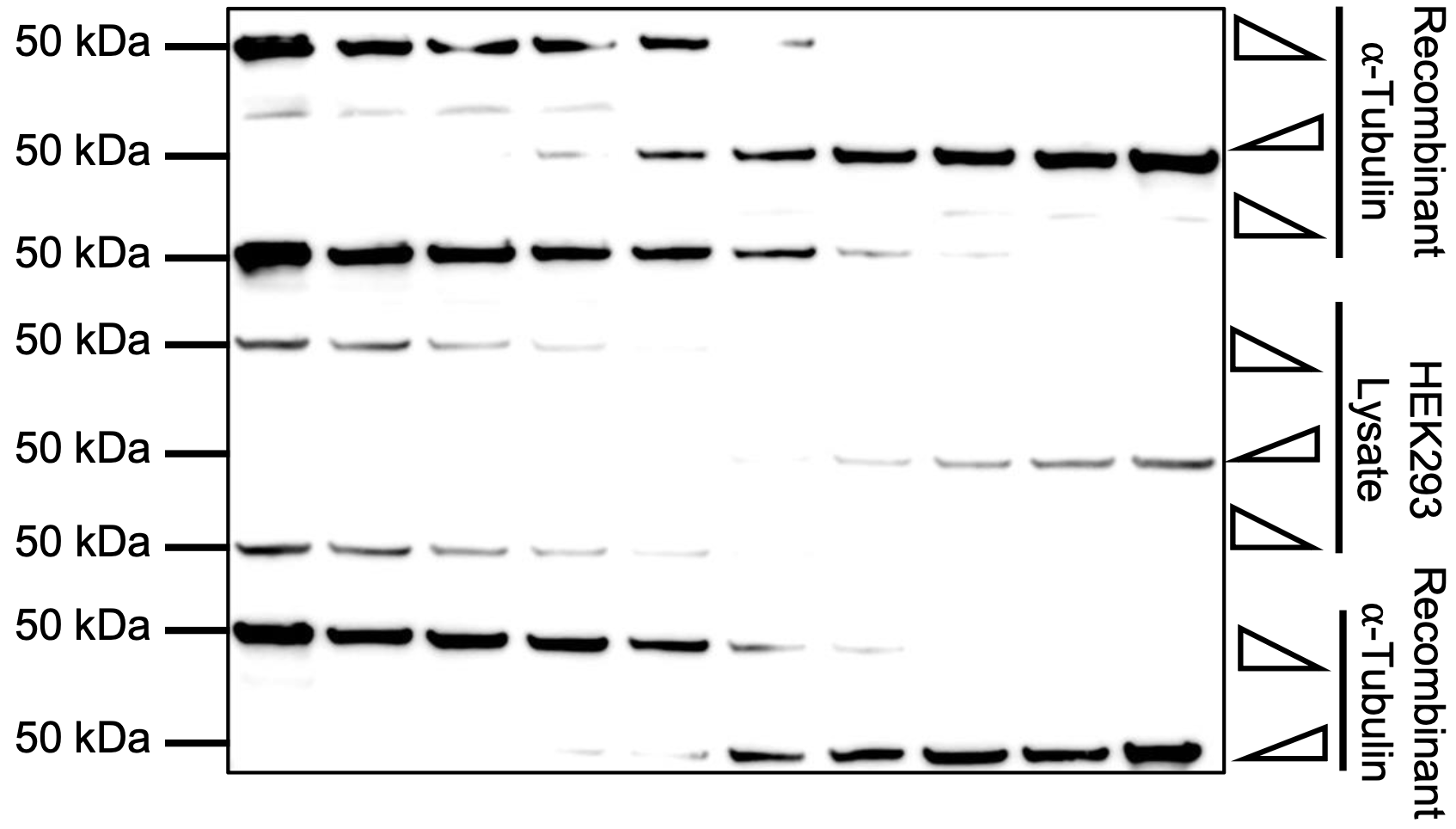
Serial dilutions of recombinant alpha tubulin were run on a traditional western blot gel and a G96 gel, transferred to the same membrane type, incubated with the same antibodies, and detected with the same chemiluminescent substrate, showing equivalent sensitivity.
The company was built by the scientists who hit this wall in their own research and engineered the fix.
A loaner evaluation confirms performance on your own panel before you commit to volume.
The difference this page can state today is structural: no instrument purchase, no proprietary cartridges, no new platform for QA to qualify, and no waiting on shared instrument time.
Yes. It runs on the same antibodies and protocols already validated in house or at the CRO, and there is no new instrument to qualify.
That works until the panel grows. Running 96 conditions the traditional way takes roughly seven gels and six to seven separate transfer and antibody rounds, compared with one gel and one round on G96. The gap widens as panels scale.
The company is founder-led by an active NIH-funded lab, with peer-reviewed validation behind the format. A loaner evaluation is also a low-risk way to confirm performance before committing to volume.
Share the compounds, doses, and timepoints you're running now, and we'll show you how they fit on a single G96, with no capital request and nothing new for QA to qualify.